Wednesday, August 3, 2016
Video Blog - The 5 Minds
In this vlog, I share how I will continue to implement Howard Gardner's 5 minds in my Media classes.

Monday, July 25, 2016
Flat Classrooms

In the world we live today, ethnocentrism seems prevalent. Whether it's wanting to build a wall to keep foreigners out or sending a bomb into a crowd of people that worship a different religion. In today's technology rich classrooms, there are ways to open the eyes of teachers and students to embrace and accept the differences among the many people of our world. According to Julie Lindsay in the 2014 YouTube interview published by Future of Education called Julie Lindsay and Vicki Davis on Flattening Classrooms, a flat classroom means, "bringing the world into your classroom and putting your classroom out to the world". I do believe that if teachers take the time to flatten our classrooms, send our students out into the world in a safe environment, they will be much better off then being confined to the 4 walls for their classroom.
Not only does flattening a classroom decrease ethnocentrism but also increases our students ethical and respectful aptitude towards those who are different than themselves. From the interview Julie Lindsay and Vicki Davis on Flattening Classrooms I can imagine the understanding and appreciating that takes place between students of two different cultures. Employing technology to communicate, children can have a better understanding of others and can eventually apply this to life outside of school. Global citizenship and respect for others will hopefully be part of the positive outcomes of a flat classroom.
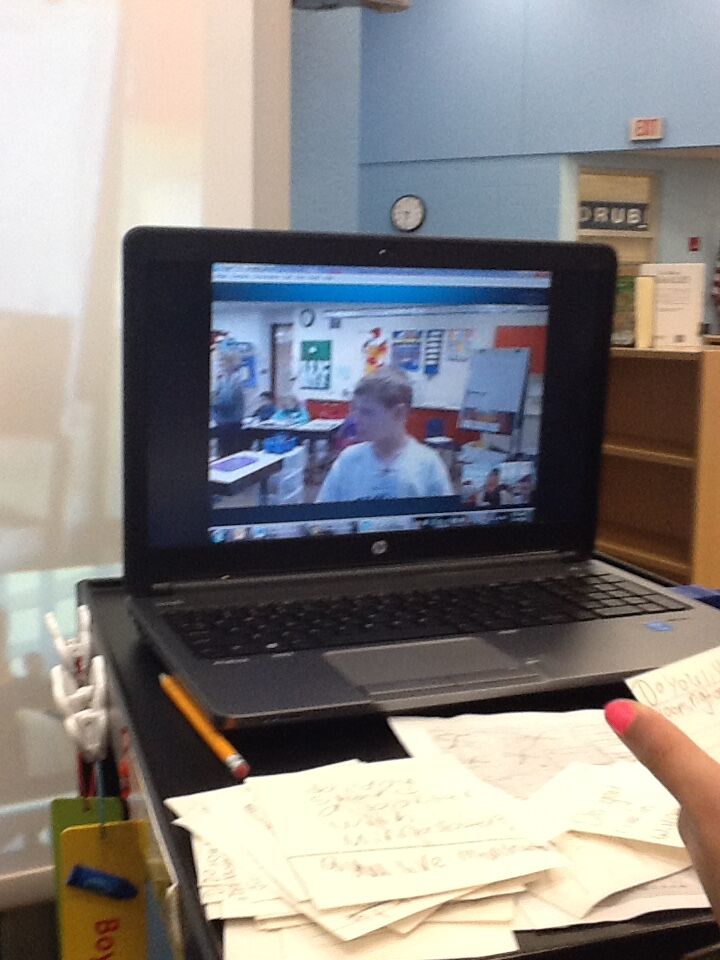
In my own classroom, Skype is a tool that I've used in various ways to flatten my classroom. For example, my students have completed numerous Mystery Skypes with students from inside and outside of the US, asked an author questions about what it's like to publish a book, Skyped with Molly the Fire Safety Dog during Fire Safety Week, and interviewed children from Argentina about life at their school. I've also used Kidblog and ePals to communicate with other schools around the world.
Before the prevalence of free use of Skype, I used ePals and emails to correspond with another teacher and her students from Columbia. Students in my 5th and 1st grade classes would ask and respond to questions through email. Again, this was long before any of my students had their own email accounts, thus this was all done through teacher accounts. My students learned an amazing amount of information about life in Columbia compared to life in the US. I can remember expending on many topics from our conversations and the students being so thirsty to learn more about their Colombian friends. Together, we would write a letter answering and asking questions, then I would transpose this into an email to the teacher in Columbia. A day or two later we would read the email together and have conversations about things we learned and things we wanted to know more about. Over the year we collaborated with this classroom my students gained a deeper understanding and respect for people who were different from themselves.
Just recently I participated in a project called Adventure 15 with my 4th grade students. Although there are many events that students can participate in on November 17th provided by Adventure 15, we just spent our time communicating with another classroom from Argentina. This time around my students were able to Skype with the class. The experience was much more rich and deep because of the instant ability to ask and answer questions. Many of my students in this class had never been out of Iowa, so the abundance of what they learned from this 30 minute Skype was amazing. I remember having a conversation about the fact that everyone in that Argentine classroom knew 2 languages, one being English. This one fact seemed to not only mystify my students but also triggered a new level of respect for people who live outside of the US.
 |
| Mystery Skype |
 |
| Mystery Skype |
 |
| What we already know from our questions during the Mystery Skype |
 |
| Skype with Molly the Fire Safety Dog |
Davis, V., L, Julie. [Future of Education]. (January 16, 2014). Flattening Classrooms. [Video File]. Retrieved from https://www.youtube.com/watch?v=RVZuwIhjQvA
Ethnocentrism. (n.d.). In Dictionary.com online. Retrieved from http://www.dictionary.com/browse/ethnocentric?s=t
Monday, July 18, 2016
A 6th Graders Take on Creativity in the Classroom
For this
blog I interviewed a student who will be entering 6th grade this
school year. He attends a small, public school district where all 7th-12th
graders have access to Apple devices in a 1:1 environment. Since he will be
just entering 6th grade, he is drawing on experiences from mostly 5th
grade. What I concluded from our conversation is that he isn’t aware his teachers
are coming up short when it comes to integrating technology. He believes his
teachers are fostering creativity, though from what he told me, this really isn’t
the case. I am trying to take into account, however, that he might not be remembering
all that he did in 5th grade.
The
interviewee stated teachers foster creativity because sometimes he is allowed
to decide which topics to research; they have leeway in the topic of research.
As I dug deeper with my questions, however, I found the teacher(s) relied solely
on Google products as a way for students to present their information. I asked
if he ever used apps or websites called Prezi, Popplet, Scratch or iMovie,
which he stated he had not. It seems the way his teachers allow students to be
creative is in choosing their fonts sizes, colors, and pictures for their
reports. I also asked if he could think of any websites or apps he wished his
teachers would use, for example, Facebook. He said he was fine with the
applications he uses and can’t think of one he wishes he could use.
From my
conversation with him, I concluded that he doesn’t know he is missing out on
opportunities to be creative. There seems to be no choice in applications or
sites. It appears the only choice is Google Docs or Google Slides, which allows
for a small amount of creativity compared to other products on the market. My interviewee
declared his teachers believe creativity important, but I, personally, do not
agree. During the interview I struggled with talking about being creative in the classroom with technology because he had little experiences to draw from.
The school
district in which the interviewee attends has technology available to students.
I am acquaintances with the Technology Integrationist for this district and I
know she would be disappointed with the lack of applications being used in the
classroom. I’m not sure if his 5th grade teach(ers) were shy about
using technology or if this is a problem prevalent in upper elementary. There
is a disconnect between the skills he is gaining in the classroom and what
creative skills he will need in the future, according to Sir Ken Robinson’s Ted
Talk (2007). I hope that when he enters into 7th grade and has the
opportunity to be in a 1:1 environment, things change for the better.
Robinson, K. (2007, January 6). Do schools kill creativity? [Video File]. Retrieved from https://www.youtube.com/watch?v=iG9CE55wbtY
Sunday, July 17, 2016
Spotlight on Strategies: Story Elements Soup
Using Smore, I created a flyer that describes how an elementary teacher, specifically
a second grade teacher, can make learning and understanding story
elements interesting by applying the strategy Story Elements Soup. In my Smore, I
explain story elements can be compared to different ingredients in a soup, such as the plot is the recipe and the theme is the broth.
Once all parts of the soup are put together, it cooks up a tasty (and interesting) story!
Teaching
story elements addresses many Iowa Core standards including reading standard RL.2.IA.1
: employ the full range of research-based comprehension strategies, including
making connections, determining importance, questioning, visualizing, making
inferences, summarizing, and monitoring for comprehension. Students need to
understand how the elements of a story fit together to create a tale worth reading.
Teaching story elements is also beneficial to a child’s writing ability; they
can transfer this knowledge to their own stories. Once students see and
understand how the parts of a story come together a students can apply this
same idea to their own short stories.
Incorporating
digital media not only helps a teacher meet a speaking and listening standard,
but also provides my students an opportunity to employ listening comprehension
skills. Also, using the website Bookflix, students are kept engaged in the book
because it is animated. Another great addition to using an online book is that
it creates an equal playing field for all levels of fluency. A student isn’t
concentrating on his or her ability to read with fluency, but instead on his or her ability to
comprehend and apply their ability to describe the story elements. Using the
app Scribble My Story also offers my students the chance to synthesize their
learning and provide evidence of their understanding of story elements. Within
the app, students can draw, type, or even record their thoughts. I really enjoy
using this app because students of any capability can present their
understanding. As Howard Gardner states, "it is advantageous to develop multiple, diverse representations of the same entity..." (2008, pg 87). Students may be using the same tool, but they are allowed to present their information in any way they deem best for their ability and creativity.
References:
Gardner, H. (2008). 5 Minds for the Future. Boston, MA: Harvard Business Press.
Iowa Core. (n.d.). Retrieved July 17, 2016 from https://iowacore.gov
Gardner, H. (2008). 5 Minds for the Future. Boston, MA: Harvard Business Press.
Iowa Core. (n.d.). Retrieved July 17, 2016 from https://iowacore.gov
Story Elements (N.D.). Teacher Vision, Retrieved from https://www.teachervision.com/skill-builder/reading-comprehension/48783.html
Monday, July 11, 2016
Do Schools Kills Creativity?
I viewed the Sir Ken Robinson TED
Talk on creativity in the cognition class I took last fall and it definitely resonated with
me. Not only is Sir Ken Robinson a wonderful storyteller who uses laughter to
engage his audience and make his presentation memorable, but he also states
great many truths about our educational system. I completely agree with him
when he states, “We have to rethink the fundamentals on which we are educating
our children” and that we need to “educate their whole being” (Robinson, 2007).
As an educational system, we are not emphasizing the whole child – we are very obsessed
with teaching towards the analytical side and less of the creative side of the
brain. To educate a successful human being in today’s ever changing, technology
rich world, we need to enhance both sides of the brain. Creativity is not held
at a high regard as does the ability to solve math problems or read with
fluency. But as Robinson states, we know in our changing world this isn’t going
to be the priority anymore and the educational system needs to realize this.
To make changes in the
system, teachers need to embrace, foster, and advocate for new ways of thinking
in their classrooms. We need to be open to students finding new ways of
processing their learning. Robinson’s TED Talk reminded me of a presentation
a colleague and I created for a technology conference. We titled our session,
Cultivating Creativity with Technology. In our session we gave examples of
different ways creativity can be cultivated. For instance, we talked about how
not all students can just write down what they hear and think, some will
remember the information better if they use apps such as Paperby53 or Skitch to
doodle their thoughts. Of course augmented reality
also popped into my head.
There are many great
apps and websites available for students and teachers to utilize in emphasizing
and fostering creativity. One of the biggest ways, I believe, teachers can have
creativity come alive in the classroom is to allow students a choice. Because
there is a myriad of options available, allow students to choose what digital
media tool works best for them in the way in which they learn best. As Robinson
states, “Intelligence is diverse – we think about the world in all the ways we
experience it” (2007). According to the 2009 Speak Up report, students are
asking for more ways to collaborate with peers. I can only imagine the creative
thinking that could be developed if more collaboration tools were employed in the
classroom (Project Tomorrow, 2010). According to Howard Gardner, the best
creators are those who are not afraid to fail and try again (Five minds for the
future, p.83). I think we can use technology to increase creativity by having
students understand that it’s okay to fail and try again. On page 87, Gardner
also states that “…it is also advantageous to develop multiple, diverse,
representations of the same entity…” (2008). With technology, we can represent
content through videos, photographs, games, etc. With numerous representations
of material, students can find new and innovative solutions. This also reminds
me of “20 Time” or “Genius Hour” in which teachers (and Google!) allow their
students to research anything they wish. Students have tons of leeway in what
they are looking for and what to do with their information. This also helps
foster discipline and synthesis, which in turn fosters creativity! If we give
students 20% of their classroom time to find something of interest and learn
more about it, imagine the creativity they will bring to their future R&D department
if students already have this experience.
In my classroom I try to
cultivate creativity in my students in having a MakerSpace available to
them. My journey to include a large MakerSpace in my Library has only just
begun this year, but I have already acquired a items such as building blocks,
straws, cardboard pieces, and much more including a MakeyMakey which will be
coming soon. I find ways to get students utilizing the MakerSpace to have an
outlet for their creativity even if it’s just a few minutes at the end of
class. I hope to expand to include items such as a BeeBot and Dash and Dot.
As I stated, there are
lots of site and apps available to aid creativity, but we must also keep in
mind that students need to have a disciplined and synthesizing mind before they
can have full creative capacities.
Resources:
Gardner, Howard. (2008). Five minds for the future. Boston: Harvard Business Pres
Project Tomorrow. (2010). Speak up
2009 - Creating our future: students speak up about their vision for 21st
century learning - March 2010. Retrieved January 7, 2011 from Project
Tomorrow Web site:http://www.tomorrow.org/speakup/pdfs/SU09UnleashingTheFuture.pdf
Robinson, K. (2007, January 6). Do schools
kill creativity. [Video File]. Retrieved from https://www.youtube.com/watch?v=iG9CE55wbtY.
Thursday, July 7, 2016
Media Infused Learning Center
I developed a Prezi presentation that explains the steps in the research process. A Prezi, as well as other media infused learning centers foster a disciplined and synthesizing mind in students. In
Howard Gardner’s book, 5 Minds for the Future Gardner lists four
steps in creating a disciplined mind; “identify truly important topics or
concepts within the discipline, spend a significant amount of time on this
topic, approach the topic in a number of ways, and set up performances of
understanding and give students ample opportunities to perform their
understanding under a variety of conditions” (2008, p 33). In creating a Prezi
presentation for the Big 6 Research Process I feel I am aiding my students in
developing a disciplined mind because they are receiving information in various
ways. The Prezi I created allows my students to understand the research process
in different of ways – listening to me talk, reading the information on the
page, and seeing examples. It also asks students to create a final project (of
their choosing) that will showcase their understanding of their research. Gardner also states, “while a specific
discipline may prioritize one kind of intelligence over the others, a good
pedagogue will invariably draw on several intelligences in inculcating key concepts
or processes” (p. 33). The Prezi fits this criterion because I am utilizing the
different ways in which students learn. For example, I will present the
research process to the class showing examples and giving instructions. Then,
students will be allowed to use my Prezi as a resource while researching. This
meets another form of learning because the Prezi includes videos and graphics. Gardner
states on page 69, “Finally, aspiring synthesizers benefit from explicit
instruction on strategies,” thus a Prezi also fosters the development of
synthesis because by using the Prezi to perform the steps in the research process my students are
practicing synthesizing information (2008).
Reference: Gardner,
H. (2008). 5 Minds for the Future. Boston, MA: Harvard Business
Press.
Wednesday, July 6, 2016
Clipping Resources Using Educlipper
As
I was curating my eduClipper board I started to realize how easy it would be to
provide my students with various ways of learning their content to meet their diverse
learning styles. I usually post links for research on my Symbaloo page but eduClipper is a great way to keep a myriad
of resources in one easily accessible place. I chose to create a board for the
Solar System because I have students research a planet in conjunction with the
Solar System unit they embark upon in their homerooms. I typically just provide
3 websites for researching, but with eduClipper I was able to also add videos and infographics as well as interactive games. I even added a copy of their
assignment! As my 4th graders went through this project last year, certain
students struggled with finding particular information for their project within
all the extra data provided on the website. Using the videos and infographics, in addition to the websites, I
know there will be students who will flourish with this assignment that may not
have previously. Adding in games was something I thought of along the way. The
games are a way for students to apply their understanding after their
assignment is completed as well as a way to help the early finishers have
something educational to complete.
Subscribe to:
Posts (Atom)