Monday, October 10, 2016
Tech Tool Tuesday - October 4th - Writing
Scholastic Story Starter: This month I am focusing on tools which aid students in increasing their writing abilities. The first tool is Story Starts from Scholastic. There is no login needed - just go to the link. This site can be used whole class or by individual students. I like this website because the story starters are fairly interesting and it's geared toward different level of writers. You can choose from four different themes, then your grade level of PreK-1st, 2nd, 3rd, or 4th-6th. Students can use the website to type their response or it can be transcribed on a piece of paper. Please see my screen-cast for further information.
Edublogs: Blogging is a wonderful way to include authentic writing. If you publish student blogs online for others to view outside the school or even make them available for peer review, you may be more likely to get students to write with enthusiasm and care. Blogs can also be a way to teach positive feedback if you allow students to comment on each other's work. I recommend Kidblog because of it's ease of use and ability to keep blogs private to just people in your classroom. The downfall is that if you don't already have an account, you will need to pay $44 per year after the free 30 day trial. If you created an account last year when it was still completely free, you don't have to worry about the price. Another place for free blogging is edublogs.org. It is less user-friendly for the students, but still manageable. If blogging is something you would like to include in your curriculum, please let me know and I can help you get set up.

Sunday, September 25, 2016
Tech Tool Tuesday - Digital Book Resources - September 20th
This week's session focused on enabling students to read from online textbooks or with book audio. There are various ways your students can read or listen to books and below I have listed four different resources with accompanying screen-casts.
Epic - an app and a website that is great for all students Prek-5. My internet is slow at home, so you couldn't see how amazing the books look since it takes a while to load.


Epic - an app and a website that is great for all students Prek-5. My internet is slow at home, so you couldn't see how amazing the books look since it takes a while to load.
Overdrive - an app and a website provided by the public libraries. You need a library card to sign in and borrow books. Students can read or listen to the books, a lot like a Kindle.
Playaway - checked out from AEA267


MackinVia - Students log in with the same username and password they use for their email addresses. Since only 2nd-5th have accounts, teachers will need to log into their own accounts for Kindergarten and first grade students.
Sunday, August 7, 2016
Discovery Education Board Builder
I
created a board with Discovery
Education's Board Builder, which is comparable to Glogster. I will utilize the
board to present recycling information to my K-5 students. The reason I chose
recycling, is due to the fact that our school just started a recycling program
last year, without much introduction or reasoning. Recycling is very important,
especially with all the paper our school uses, but I do not feel our students
understand the significance because of their lack of knowledge in the subject.
I can exhibit this board to my students at the beginning of the year to help
them understand why our school should recycle; how it is part of our civic duty.
There
are other ways I can employ Board Builder in my classroom this year, especially
to develop respectful and ethical minds in my students. Gardner talks about a
respectful mind being one that understands and positively regards the
differences in others. Using Board Builder, a teacher can help students achieve
this by presenting information about people from other cultures and societies.
This tool can also be used to explain, give examples, and provide opportunities
for one to understand what it means to be respectful to others. The same can be
true for forming an ethical mind.
Ethics
is a subject that can be hard to teach elementary students. In my example, I
chose a topic that exemplifies the embodiment of being a good citizen of our
community. Board Builder can be used as a model with other subjects such as cheating,
fairness, and acceptance. Videos, images, links, and assessments aid in making
Board Builder a successful way to meet various learning styles as well as offer
the opportunity to understand information in various modalities. Embedding an
assessment or assignment within the Board Builder aids the teacher in gaging
the effectiveness of the tool and comprehension of the learner.
Wednesday, August 3, 2016
Video Blog - The 5 Minds
In this vlog, I share how I will continue to implement Howard Gardner's 5 minds in my Media classes.
Monday, July 25, 2016
Flat Classrooms

In the world we live today, ethnocentrism seems prevalent. Whether it's wanting to build a wall to keep foreigners out or sending a bomb into a crowd of people that worship a different religion. In today's technology rich classrooms, there are ways to open the eyes of teachers and students to embrace and accept the differences among the many people of our world. According to Julie Lindsay in the 2014 YouTube interview published by Future of Education called Julie Lindsay and Vicki Davis on Flattening Classrooms, a flat classroom means, "bringing the world into your classroom and putting your classroom out to the world". I do believe that if teachers take the time to flatten our classrooms, send our students out into the world in a safe environment, they will be much better off then being confined to the 4 walls for their classroom.
Not only does flattening a classroom decrease ethnocentrism but also increases our students ethical and respectful aptitude towards those who are different than themselves. From the interview Julie Lindsay and Vicki Davis on Flattening Classrooms I can imagine the understanding and appreciating that takes place between students of two different cultures. Employing technology to communicate, children can have a better understanding of others and can eventually apply this to life outside of school. Global citizenship and respect for others will hopefully be part of the positive outcomes of a flat classroom.
In my own classroom, Skype is a tool that I've used in various ways to flatten my classroom. For example, my students have completed numerous Mystery Skypes with students from inside and outside of the US, asked an author questions about what it's like to publish a book, Skyped with Molly the Fire Safety Dog during Fire Safety Week, and interviewed children from Argentina about life at their school. I've also used Kidblog and ePals to communicate with other schools around the world.
Before the prevalence of free use of Skype, I used ePals and emails to correspond with another teacher and her students from Columbia. Students in my 5th and 1st grade classes would ask and respond to questions through email. Again, this was long before any of my students had their own email accounts, thus this was all done through teacher accounts. My students learned an amazing amount of information about life in Columbia compared to life in the US. I can remember expending on many topics from our conversations and the students being so thirsty to learn more about their Colombian friends. Together, we would write a letter answering and asking questions, then I would transpose this into an email to the teacher in Columbia. A day or two later we would read the email together and have conversations about things we learned and things we wanted to know more about. Over the year we collaborated with this classroom my students gained a deeper understanding and respect for people who were different from themselves.
Just recently I participated in a project called Adventure 15 with my 4th grade students. Although there are many events that students can participate in on November 17th provided by Adventure 15, we just spent our time communicating with another classroom from Argentina. This time around my students were able to Skype with the class. The experience was much more rich and deep because of the instant ability to ask and answer questions. Many of my students in this class had never been out of Iowa, so the abundance of what they learned from this 30 minute Skype was amazing. I remember having a conversation about the fact that everyone in that Argentine classroom knew 2 languages, one being English. This one fact seemed to not only mystify my students but also triggered a new level of respect for people who live outside of the US.
 |
| Mystery Skype |
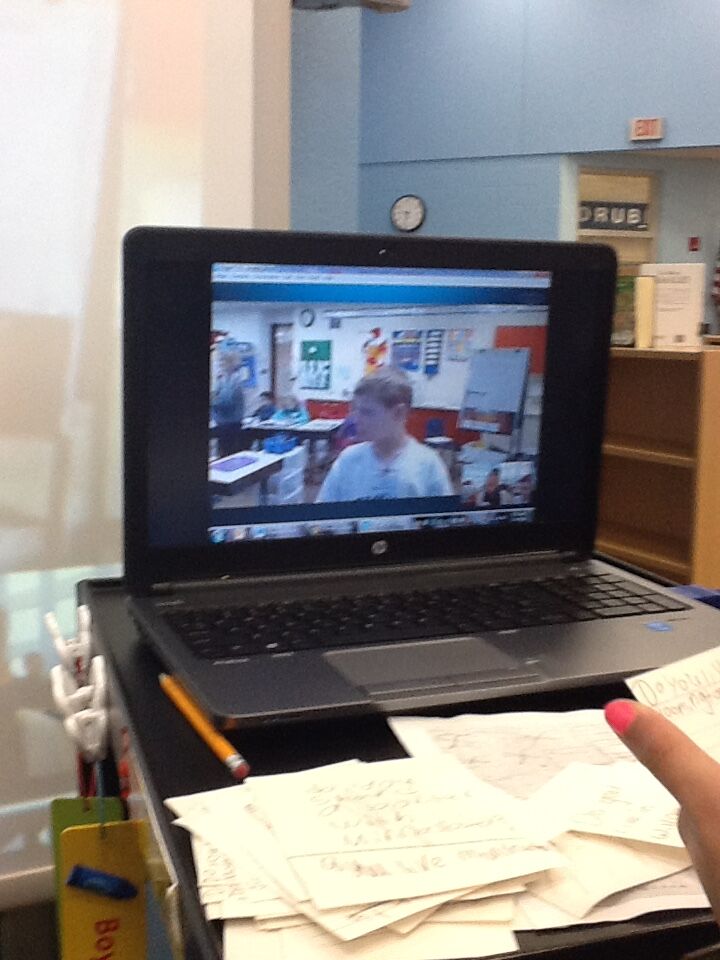 |
| Mystery Skype |
 |
| What we already know from our questions during the Mystery Skype |
 |
| Skype with Molly the Fire Safety Dog |
Davis, V., L, Julie. [Future of Education]. (January 16, 2014). Flattening Classrooms. [Video File]. Retrieved from https://www.youtube.com/watch?v=RVZuwIhjQvA
Ethnocentrism. (n.d.). In Dictionary.com online. Retrieved from http://www.dictionary.com/browse/ethnocentric?s=t
Monday, July 18, 2016
A 6th Graders Take on Creativity in the Classroom
For this
blog I interviewed a student who will be entering 6th grade this
school year. He attends a small, public school district where all 7th-12th
graders have access to Apple devices in a 1:1 environment. Since he will be
just entering 6th grade, he is drawing on experiences from mostly 5th
grade. What I concluded from our conversation is that he isn’t aware his teachers
are coming up short when it comes to integrating technology. He believes his
teachers are fostering creativity, though from what he told me, this really isn’t
the case. I am trying to take into account, however, that he might not be remembering
all that he did in 5th grade.
The
interviewee stated teachers foster creativity because sometimes he is allowed
to decide which topics to research; they have leeway in the topic of research.
As I dug deeper with my questions, however, I found the teacher(s) relied solely
on Google products as a way for students to present their information. I asked
if he ever used apps or websites called Prezi, Popplet, Scratch or iMovie,
which he stated he had not. It seems the way his teachers allow students to be
creative is in choosing their fonts sizes, colors, and pictures for their
reports. I also asked if he could think of any websites or apps he wished his
teachers would use, for example, Facebook. He said he was fine with the
applications he uses and can’t think of one he wishes he could use.
From my
conversation with him, I concluded that he doesn’t know he is missing out on
opportunities to be creative. There seems to be no choice in applications or
sites. It appears the only choice is Google Docs or Google Slides, which allows
for a small amount of creativity compared to other products on the market. My interviewee
declared his teachers believe creativity important, but I, personally, do not
agree. During the interview I struggled with talking about being creative in the classroom with technology because he had little experiences to draw from.
The school
district in which the interviewee attends has technology available to students.
I am acquaintances with the Technology Integrationist for this district and I
know she would be disappointed with the lack of applications being used in the
classroom. I’m not sure if his 5th grade teach(ers) were shy about
using technology or if this is a problem prevalent in upper elementary. There
is a disconnect between the skills he is gaining in the classroom and what
creative skills he will need in the future, according to Sir Ken Robinson’s Ted
Talk (2007). I hope that when he enters into 7th grade and has the
opportunity to be in a 1:1 environment, things change for the better.
Robinson, K. (2007, January 6). Do schools kill creativity? [Video File]. Retrieved from https://www.youtube.com/watch?v=iG9CE55wbtY
Sunday, July 17, 2016
Spotlight on Strategies: Story Elements Soup
Using Smore, I created a flyer that describes how an elementary teacher, specifically
a second grade teacher, can make learning and understanding story
elements interesting by applying the strategy Story Elements Soup. In my Smore, I
explain story elements can be compared to different ingredients in a soup, such as the plot is the recipe and the theme is the broth.
Once all parts of the soup are put together, it cooks up a tasty (and interesting) story!
Teaching
story elements addresses many Iowa Core standards including reading standard RL.2.IA.1
: employ the full range of research-based comprehension strategies, including
making connections, determining importance, questioning, visualizing, making
inferences, summarizing, and monitoring for comprehension. Students need to
understand how the elements of a story fit together to create a tale worth reading.
Teaching story elements is also beneficial to a child’s writing ability; they
can transfer this knowledge to their own stories. Once students see and
understand how the parts of a story come together a students can apply this
same idea to their own short stories.
Incorporating
digital media not only helps a teacher meet a speaking and listening standard,
but also provides my students an opportunity to employ listening comprehension
skills. Also, using the website Bookflix, students are kept engaged in the book
because it is animated. Another great addition to using an online book is that
it creates an equal playing field for all levels of fluency. A student isn’t
concentrating on his or her ability to read with fluency, but instead on his or her ability to
comprehend and apply their ability to describe the story elements. Using the
app Scribble My Story also offers my students the chance to synthesize their
learning and provide evidence of their understanding of story elements. Within
the app, students can draw, type, or even record their thoughts. I really enjoy
using this app because students of any capability can present their
understanding. As Howard Gardner states, "it is advantageous to develop multiple, diverse representations of the same entity..." (2008, pg 87). Students may be using the same tool, but they are allowed to present their information in any way they deem best for their ability and creativity.
References:
Gardner, H. (2008). 5 Minds for the Future. Boston, MA: Harvard Business Press.
Iowa Core. (n.d.). Retrieved July 17, 2016 from https://iowacore.gov
Gardner, H. (2008). 5 Minds for the Future. Boston, MA: Harvard Business Press.
Iowa Core. (n.d.). Retrieved July 17, 2016 from https://iowacore.gov
Story Elements (N.D.). Teacher Vision, Retrieved from https://www.teachervision.com/skill-builder/reading-comprehension/48783.html
Subscribe to:
Posts (Atom)